
VHUB

****Sponsored by LFG Equities Corp

VHUB is replacing the traditional convenience store model entirely with an Autonomous, Robot-Operated Alternative
VenHub enters the Florida market through a new operator-led deployment model, marking a key step in its U.S. commercial rollout
VenHub Opens Second, Larger Las Vegas Production Facility, Significantly Expanding Manufacturing Capacity as Commercial Demand for Company’s Smart Stores Continues to Build Across Priority Verticals
View The Investor Presentation HERE
________________________________
Hello Everyone,
VenHub Global, Inc. (NASDAQ: VHUB) is building something that sounds like science fiction until you realize it's already being installed: a fully autonomous, robot-run convenience store that operates around the clock without a single employee on site, cuts out checkout lines entirely, and can reportedly be up and running at a new location in about a week.
VenHub is essentially the front of the house, the spot where a human used to stand behind a counter, take payment, and hand over the product. The concept hasn't changed, only who's doing the work. By letting machines handle the repeatable parts of the job, a store can run longer hours with far less labor drag, opening the door to locations that were previously too expensive or too impractical to staff around the clock. That's why the more useful comparison isn't a traditional convenience chain at all. It's any business model built around turning physical operations into a repeatable unit that can be deployed the way infrastructure gets deployed, one node at a time, scaled out as demand supports it.
Strip away the buzzwords and here's what a VenHub Smart Store actually is: a self-contained retail box stocked with everyday essentials, run start to finish by robotic arms and AI. A customer places an order, and the system handles the picking, sorting, packaging, and hand-off through a pickup window, no cashier, no browsing the aisles, no line to stand in. The robotic hardware comes from a major name in global robotics, running on VenHub's own firmware, and the computer vision behind it reportedly identifies products with close to 99% accuracy while handling up to 80 customers an hour without any human staff involved. VenHub has also been building out a serious intellectual property position around this, with more than 20 patent applications filed across robotics, automation, AI, and store operations, and more in the pipeline. The format itself is flexible too, with fixed units for permanent indoor or outdoor placement, mobile units on wheels for events and seasonal demand, and retrofit kits that can convert existing retail space into an automated setup.
The market this is aimed at is enormous. The global convenience store industry was valued at roughly $2.1 trillion in 2021 and is on track to hit $3.1 trillion by 2028, and that's before accounting for the more specific automation trend layered on top of it. The unmanned convenience store segment alone is projected to grow at a 52% compound annual rate on its way to $1.6 billion by 2027, while the broader retail automation market is expected to reach $44.3 billion by 2029. Retailers are already leaning hard into this shift, with an estimated 70% of routine store tasks expected to be automated industry-wide, and theft and shrinkage costing retailers north of $112 billion in a single year giving operators an obvious financial reason to want fewer vulnerable, employee-dependent locations. VenHub is positioning its stores for exactly the kind of high-traffic, low-friction locations that fit this trend: college campuses, transit hubs, apartment communities, business districts, hospitals, and tourist destinations.
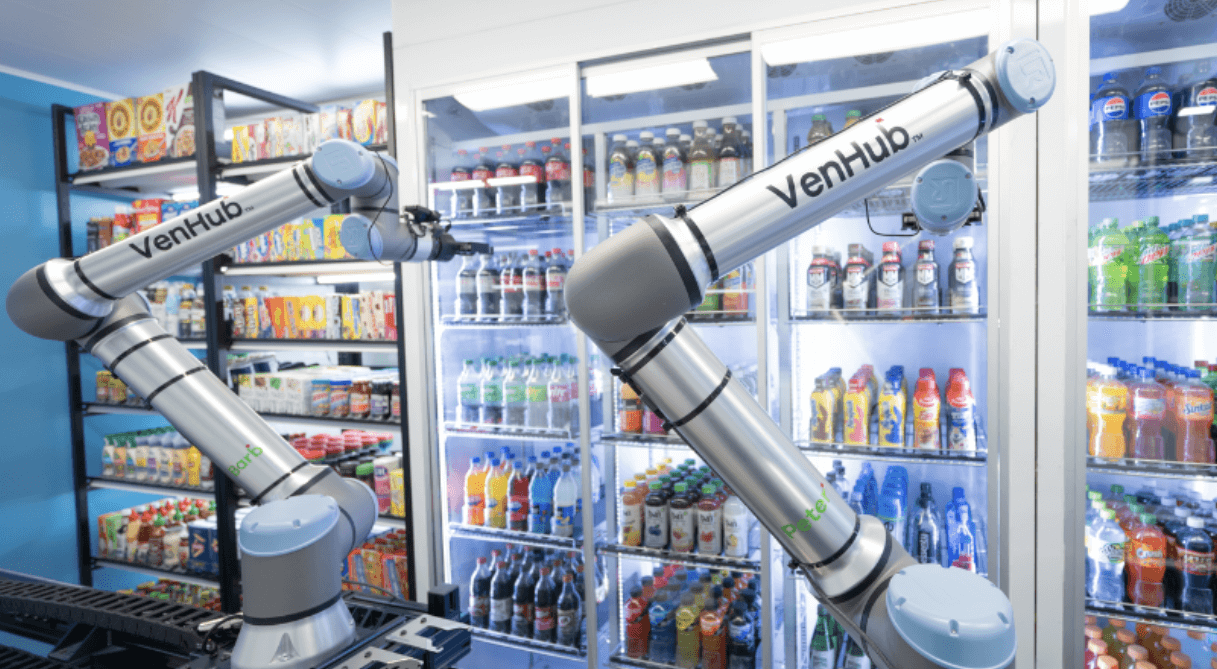
The business model is built to generate revenue on both ends. Each store carries an expected hardware price tag of around $275,000 including installation, and then generates recurring income on top of that through a $2,500 monthly software subscription covering cloud-based store control and AI inventory management, plus a $1,300 monthly maintenance fee for monitoring, repairs, and system upkeep. Layer in additional revenue from advertising, brand partnerships, data, and fulfillment services, and each store is projected to throw off close to $46,000 in annual recurring revenue on top of the initial hardware sale. Management is guiding toward gross margins near 53% and adjusted EBITDA margins around 32% on a run-rate basis, with relatively light capital and operating expense requirements that could help the model scale if demand holds up.
Since going public back in January, VenHub has kept the momentum going with a run of new deployments and infrastructure buildout. The company is partnering with Circa Resort & Casino in Las Vegas on a first-of-its-kind 66-foot Smart Store setup, combining three autonomous units into a single integrated retail environment, and it has also signed agreements with several independent operators to bring six new Smart Stores online across the greater Las Vegas metro area. To support that growth, VenHub opened a second, significantly larger production and assembly facility in Las Vegas, expanding manufacturing capacity alongside its headquarters and existing operations and bringing engineering, manufacturing, testing, and deployment prep together under one roof.
The technology itself keeps advancing too. VenHub introduced a new Vision System that uses AI and computer vision to automate shelf calibration, generate real-time planograms, recognize products as they're placed on shelves, and adjust merchandising dynamically based on time of day, demand, and consumer behavior. The company also rolled out self-diagnosing robotics and Smart Health Monitoring across its robotic arms, dynamic bins, and intelligent refrigerators, aimed at keeping Smart Store uptime as high as possible. On the IP side, VenHub now has 24 pending patent applications spanning smart retail infrastructure, display systems, autonomous retail operations and mobility, and advanced security and protection systems. The company has also deepened its relationship with Stripe, formalizing it as its primary payments infrastructure partner.
VenHub has been in R&D since 2023 and has four stores open today, but the more telling number might be the order book: the company says it has collected more than 1,000 pre-orders across 48 states, representing over $300 million in potential revenue, with deliveries on those orders expected to start this year. To fill that pipeline, VenHub is planning a two-tier manufacturing and support network, with large Mega Centers on both the west and east coasts capable of producing up to 2,500 stores a year at full capacity, backed by smaller regional Micro Centers handling maintenance and repairs for stores in their area. The rollout plan starts in Southern California, Nevada, and nearby states along with major NFL markets, before expanding nationally and eventually into the EU, with additional plans for partnerships across transit, municipal, and hospitality sectors and co-branding deals with established retail names.
The broader tailwind here is real. Industry forecasters expect robotics adoption to keep expanding in the years ahead, driven by labor constraints and efficiency pressures across the wider economy. So when investors ask whether VHUB deserves a seat in that robotics conversation, the honest answer is yes, provided the product actually does what the company says it does: robotics, machine vision, sensors, and automated fulfillment combining into a store that can reportedly run 24 hours a day without staff. VenHub has already tied that pitch to real-world deployments in high-traffic transportation hubs, including LAX, and has positioned CES 2026 as a live, working proof point in front of the industry.
Whether VenHub can pull off a full replacement of the traditional convenience store is still an open question, but the early signals are hard to ignore. The opportunity for investors isn't that a single Smart Store exists, it's that the format is designed to be repeated and networked the way early automation winners scaled from one facility to hundreds, backed by a four-figure pre-order book already worth hundreds of millions, a revenue model that pairs upfront hardware sales with recurring software and maintenance income, and margin targets that would look strong for almost any retail concept. That's the lane VHUB is trying to claim, at a moment when the category is still young enough that no clear leader has locked it up, making it a name worth watching as it moves from four stores to whatever comes next.
NEWS
VenHub Highlights Proprietary AI, Robotics and Autonomous Retail Technology, Smart Store Expansion and Growth Pipeline
Jul 30, 2026•
VenHub Introduces New Features that Provide an Even Faster, Easier and More Accessible Shopping Experience Across its Smart Store Retail Platform
Jun 11, 2026•
VenHub Global Expands Autonomous Retail Platform into Florida
Jun 9, 2026•
VenHub Backs Culver City GoPass Program, Helping Deliver More Than 56,000 Student Transit Trips
Jun 3, 2026•
Jay Heller, CEO at K Lab AI, Appointed to VenHub Advisory Board
May 28, 2026•
VenHub Opens Second, Larger Las Vegas Production Facility
May 27, 2026•
VenHub Extends Flagship Smart Store Partnership at LAX/Metro Transit Center for Additional Two Years
May 26, 2026•
VenHub Highlights Rapid Progress Since Nasdaq Debut Including Expanded Smart Store Deployments, Enhanced Technology Platform and Increased Las Vegas Production Capacity
May 6, 2026•
VenHub Ranks Top 10 in Retail on Fast Company’s Most Innovative Companies List
Mar 26, 2026•
Circa Resort & Casino and VenHub Team Up to Bring the First of its Kind Autonomous Smart Store to Circa’s Guests
Mar 24, 2026
MANAGEMENT
Sincerely,
