
GTBP

****Sponsored by TD Media, LLC on Behalf of GT Biopharma

GT Biopharma Doses First Patient in GTB-5550 — The Platform Just Got a Whole Lot More Interesting
The TriKE® platform is modular, scalable, and already validated in human patients
The TriKE® platform is not speculative — it has already demonstrated clinical proof of concept
GTBP is Moving North and May be in the Midst of a Bull Run as of Last Week
READ THE INVESTOR PRESENTATION HERE
_________________________________
Hello Everyone,
We have something super exciting for you to look at for today's session. This one has been on a rampage over the last week, almost doubling since Tuesday's close of 5.23 and hitting a high yesterday of 10.80 with interest dramatically picking up. The lion share of that came on Friday when the company presented via webinar on the development of their cancer treatment platform.
Turn your attention to GTBP immediately.
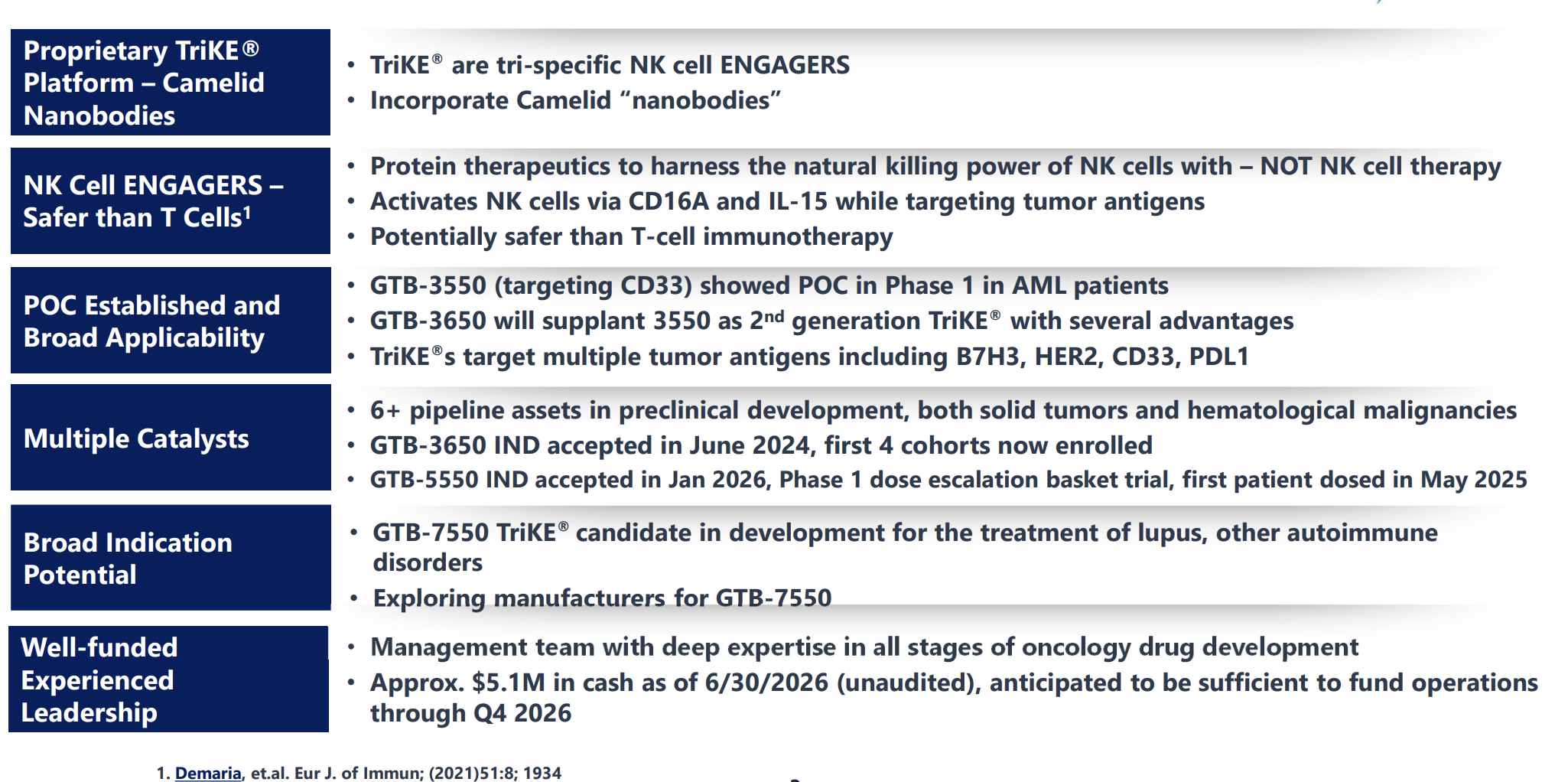
GT Biopharma is a San Francisco-based clinical-stage biopharmaceutical company developing next-generation immuno-oncology therapeutics built around its proprietary TriKE® (Tri-Specific NK Cell Engager) platform. Unlike CAR-T therapies, which require harvesting and modifying a patient's cells outside the body, the TriKE® approach is designed to activate and enhance a patient's own natural killer (NK) cells directly in vivo — a potentially safer, more scalable, and more commercially attractive approach to cancer immunotherapy.
The company holds an exclusive worldwide license with the University of Minnesota to develop and commercialize the TriKE® technology. The platform is built around a tri-specific molecule with three functional domains: an anti-CD16 nanobody that binds and activates NK cells, an IL-15 crosslinker that promotes NK cell expansion and persistence at the tumor site, and an anti-tumor binding domain that directs those NK cells to specific cancer markers. This modular design allows GT Biopharma to efficiently adapt the platform across multiple tumor targets — a meaningful structural advantage.
The Pipeline
The Platform: Teaching Natural Killer Cells to Hunt
GT Biopharma is a clinical-stage immuno-oncology company developing therapeutics based on its proprietary TriKE® --- tri-specific killer engager --- natural killer cell engager platform, licensed from the University of Minnesota. Natural killer cells are part of the innate immune system and help identify and eliminate abnormal cells, while a TriKE molecule is designed to connect those NK cells to a specific cancer target and deliver a built-in interleukin-15 signal intended to support NK-cell expansion and persistence. In practical terms, the platform is designed to help direct the body's own first-line immune defenders toward tumor cells.
The appeal of a platform approach, rather than a single asset, is that the same core technology can potentially be redirected across different disease targets by changing the tumor-binding component. GT Biopharma's pipeline reflects that broader logic, spanning hematologic malignancies, solid tumors and, in earlier-stage work, autoimmune disease.
The Pipeline: From Blood Cancers to Solid Tumors
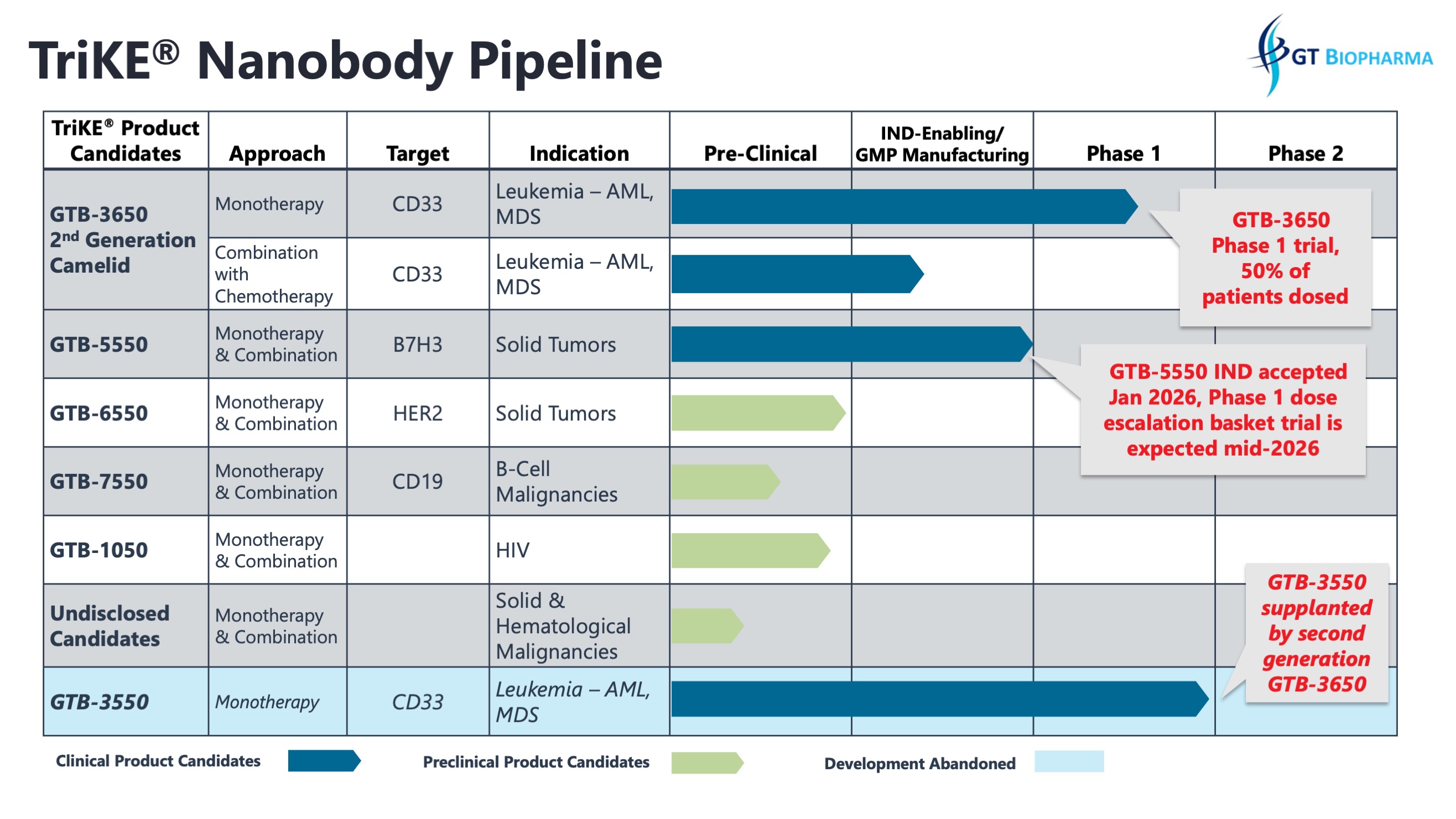
The lead active clinical program is GTB-3650, a second-generation, camelid-nanobody TriKE in a Phase 1 dose-escalation trial for relapsed or refractory CD33-expressing hematologic malignancies, specifically acute myeloid leukemia (AML) and high-risk myelodysplastic syndrome (MDS). That trial is designed to evaluate the candidate in approximately 14 patients across seven dose cohorts, ranging from 1.25 µg/kg/day up to 100 µg/kg/day, with dosing delivered in two-week-on, two-week-off blocks. The company has reported advancing through successive cohorts and approaching the dose range its preclinical leukemia models predicted could be where efficacy emerges.
The newest clinical entrant, GTB-5550, targets B7-H3, a marker expressed on the surface of a range of advanced solid tumors, in a Phase 1 dose-escalation basket trial. Its first-patient dosing in May marks GT Biopharma's expansion from the blood-cancer setting, where NK-cell approaches have shown some early promise, into the much larger solid-tumor opportunity. Behind those current active clinical programs is GTB-3550, an earlier clinical TriKE candidate that was replaced by the second-generation GTB-3650, while GTB-7550 remains an earlier-stage candidate the company is developing for CD19-positive lymphoid malignancies and autoimmune disease.
Why the Valuation Gap Matters
The reason this story attracts attention is the mismatch between the breadth of the pipeline and the company's valuation. GT Biopharma's market capitalization remains modest relative to many clinical-stage oncology peers, even after moving three TriKE candidates into human testing over time and advancing a platform licensed from a leading cancer-research university. In biotech, that kind of disconnect is often what draws speculative interest: if even one program delivers, the upside could be meaningful relative to the current valuation; if the programs stall or the company cannot fund them, the downside is equally real.
That tension --- a credible platform and clinical progress on one side, a micro-cap balance sheet and the perennial financing needs of clinical-stage biotech on the other --- is the heart of the GT Biopharma question. Michael Breen serves as Executive Chairman and Chief Executive Officer. Clinical-stage immuno-oncology remains one of the market's highest-risk segments, and the fact that multiple candidates have reached the clinic does not guarantee that any will succeed.
Why the B7-H3 Target Matters
The move into solid tumors with GTB-5550 is strategically significant because solid tumors represent the overwhelming majority of cancer cases --- and the part of the market where cell-based immunotherapies have historically struggled most. Blood cancers are often the earlier proving ground because malignant cells circulate and can be more accessible to immune effectors, whereas solid tumors are protected by a hostile tumor microenvironment that can suppress immune activity. A target like B7-H3 is attractive because it is broadly expressed across a range of solid tumors while having more limited expression in healthy tissue.
By designing GTB-5550 as a basket trial --- a study that enrolls patients with multiple tumor types under one protocol --- GT Biopharma is positioning to learn more quickly which cancers, if any, may respond. That structure can be efficient for an early-stage company because it allows broader early signal detection without committing the program to a single indication at the outset. It is a practical design for a company trying to extract maximum information from limited resources.
A Platform Built in Generations
Part of what gives the TriKE story credibility is that it has evolved through successive technical generations rather than resting on a single construct. The company's first clinical molecule, GTB-3550, served as an earlier proof-of-concept program in AML and MDS before being replaced by GTB-3650. The current lead, GTB-3650, is a second-generation molecule that incorporates camelid-nanobody technology --- small, stable antibody fragments derived from camelids --- to bind the CD16 receptor on NK cells more effectively, while GTB-5550 extends that same second-generation engineering toward the B7-H3 target in solid tumors.
That progression matters because it suggests repeatable platform engineering rather than a one-off asset. Each generation has aimed to improve NK-cell engagement, persistence, and tumor targeting. For investors evaluating a platform company, one of the central questions is whether the technology can be improved and retargeted across multiple disease settings; GT Biopharma's multi-generation, multi-target pipeline is the company's answer to that question, even though clinical outcomes remain unproven.
The Peer Landscape
GT Biopharma operates within the broader field of companies trying to harness natural killer cells and innate immunity against disease. Nkarta, Inc. (Nasdaq: NKTX) is among the better-capitalized NK-cell developers, while Iovance Biotherapeutics, Inc. (Nasdaq: IOVA) represents a more advanced immunotherapy company operating in the broader solid-tumor space.
Further along the scale, Fate Therapeutics, Inc. (Nasdaq: FATE) has long been associated with NK- and T-cell platform work, while ImmunityBio, Inc. (Nasdaq: IBRX) markets an NK-cell-activating immunotherapy and continues to advance a broader immuno-oncology pipeline. Against that group, GT Biopharma's distinguishing features are the number of TriKE candidates it has moved into human testing relative to its size and a valuation that remains below many of its immune-cell-focused peers.
GT Biopharma Doses First Patient in GTB-5550 — The Platform Just Got a Whole Lot More Interesting
GT Biopharma crossed a major threshold this year, announcing that the first patient has been dosed in its Phase 1 clinical trial evaluating GTB-5550, its B7-H3-targeted NK cell engager for solid tumors. For a company with a market cap still sitting below $12 million, this is the kind of catalyst that tends to get overlooked until it isn't — and investors paying attention now may be glad they did. GT Biopharma is no longer a one-trial story. With GTB-3650 actively enrolling in blood cancers and GTB-5550 now in the clinic targeting solid tumors, the company has quietly become a two-trial clinical-stage biopharmaceutical company operating on two of the most important fronts in cancer immunotherapy.
What makes GTB-5550 particularly compelling is the target. B7-H3 is broadly expressed across many of the most common and difficult-to-treat solid tumor cancers, and in metastatic castration-resistant prostate cancer specifically, it is present in over 90% of tumors. That is not a niche indication — that is a massive addressable patient population, and the company is going after it with a platform that has already demonstrated proof of concept in human patients. Equally important is the dosing innovation: GTB-5550 will be administered via subcutaneous injection rather than intravenously, making it more patient-friendly and potentially far more practical from a commercial standpoint down the road.
The trial itself is well structured. The Phase 1a dose escalation phase starts with prostate cancer patients and works through up to six dose levels to identify the maximum tolerated dose, with PSA serving as an early biomarker of activity — meaning the market could start seeing meaningful signals relatively quickly. From there, the Phase 1b expansion phase broadens to up to seven solid tumor types including ovarian, breast, lung, pancreatic, head and neck, and bladder cancers. Patients will be followed for 12 months tracking progression-free survival and overall survival, and the company has committed to providing updates throughout the second half of 2026.
The bottom line is straightforward. GT Biopharma now has two active clinical programs, a funded runway into Q4 2026, a Q3 data update coming on GTB-3650, and a freshly initiated trial in solid tumors that covers some of the largest cancer markets in the world. The TriKE® platform is modular, scalable, and already validated in human patients. For investors who follow early-stage biotech, this is exactly the kind of setup worth watching closely — a platform with real science behind it, multiple near-term catalysts ahead, and a valuation that has not yet caught up to the story.
GTB-3650 TriKE®
GTB-3650 is the company's first 2nd generation camelid nanobody TriKE® being tested clinically for the treatment of CD33 positive leukemias, including AML and MDS. GTB-3650 TriKE is the first TriKE clinical product that utilizes camelid nanobody technology. GTB-3650 TriKE is a Tri-specific Killer Engager molecule composed of a camelid nanobody that binds the CD16 receptor on NK cells, a single chain variable fragment (scFv) that recognizes CD33 on tumor cells, and human wild type IL-15. The IND application was cleared and enrollment started January 21, 2025. The ongoing Phase 1 dose escalation study is evaluating GTB-3650 for relapsed or refractory (r/r) CD33 expressing hematologic malignancies, including refractory acute myeloid leukemia and high-risk myelodysplastic syndrome. Enrollment in Cohort 4 (10 µg/kg/day) is ongoing, and the Company expects to initiate dosing in Cohort 5 (25 µg/kg/day) in Q2 2026. The Company anticipates providing the next update in the third quarter of 2026, which would include longer term follow-up on the six patients in Cohort 1 through 3 as well as initial observations from patients in Cohort 4 and Cohort 5. Dose escalation may continue up to Cohort 7 as necessary with the potential to evaluate GTB-3650 in a total of 14 patients (two patients per cohort). GTB-3650 is dosed in two-week blocks, two weeks on and two weeks off, for up to four months based on clinical benefit. The trial aims to assess the safety, pharmacokinetics, pharmacodynamics, in vivo expansion of endogenous patient NK cells and clinical activity. More details can be found on clinicaltrials.gov with the identifier: NCT06594445.
GTB-5550 TriKE®
GTB-5550 is a camelid (cam) anti-CD16/WT IL-15/cam anti-B7-H3 tri-specific natural killer (TriKE) cell engager, with a single chain recombinant TriKE® comprised of three components joined by flexible linkers: 1) a nanobody arm that engages the CD16 activating receptor (camelid anti-CD16) on natural killer (NK) cells; 2) a wildtype IL-15 (WT IL-15) linker arm to drive NK cell proliferation, priming, and survival; and 3) a nanobody arm that specifically engages B7-H3 (camelid anti-B7-H3) to target the antigen expressed on tumor cells.
The Phase 1 basket trial with GTB-5550 will be the first dual nanobody TriKE® tested with more patient-friendly subcutaneous dosing. The Phase 1a dose escalation portion of the trial will test up to 6 dose levels to identify the maximum tolerated dose (MTD). After the dose escalation phase, the Phase 2 expansion component of the trial will then confirm the MTD identified in the Phase 1a trial in up to seven different possible metastatic disease cohorts (castration-resistant prostate cancer, ovarian cancer, breast cancer, head and neck cancer, non-small cell lung cancer, pancreatic cancer, and bladder cancer) and further evaluate its safety, tolerability and preliminary anti-tumor activity. The Company remains well on track to initiate the trial in mid-2026.
GTB-5550 will be administered by subcutaneous (SQ) injection in the abdominal area for 5 consecutive days during Week 1 and Week 2 followed by 2 weeks of no treatment. One treatment cycle is 4 weeks in duration. A minimum of 2 cycles is planned, and patient-appropriate disease reassessment is performed after 2 cycles and every 8-12 weeks thereafter. Treatment may continue until disease progression, unacceptable toxicity, patient refusal, or treatment is no longer in the best interest of the patient. Patients are followed for 12 months to determine progression free survival (PFS) and overall survival (OS).
GTB-7550 TriKE®
The GTB-7550 TriKE product candidate is in development for the treatment of CD19 positive lymphoid malignancies and autoimmune disease. GTB-7550 TriKE is a tri-specific molecule composed of a camelid nanobody that binds the CD16 receptor on NK cells, the single chain variable fragment (scFv) of an anti-CD19 antibody, and human wild type IL-15. GTB-7550 TriKE has been tested and published pre-clinically using models of lymphoma and chronic lymphocytic leukemia. Based on its early preclinical activity targeting normal B-cells, studies are ongoing to develop GTB-7550 in autoimmune disease.
GTB-3550 TriKE® (Supplanted by Second Generation GTB-3650)
GTB-3550 was the company's 1st clinical trial using a 1st generation TriKE product candidate that was initially evaluated in a Phase 1 clinical trial for the treatment of relapsed/refractory acute myeloid leukemia (AML) and high-risk myelodysplastic syndromes (MDS). GTB-3550 is a single-chain, tri-specific scFv recombinant fusion protein conjugate composed of the variable regions of the heavy and light chains of anti-CD16 and anti-CD33 antibodies and human mutant IL-15. In the completed Phase 1 clinical study, GTB-3550 was shown to be safe and well-tolerated. The study of GTB-3550 demonstrated clinical proof of concept of in vivo activity. GTB-3550 and the 1st generation platform was discontinued after strong data suggested that the 2nd generation TriKE was more potent and exhibited better preclinical anti-tumor activity with camelid nanobody technology and wild type IL-15.

GT Biopharma Provides Update on Pipeline Discovery Activities from Newly Implemented AI-Based Technological Initiatives
Published
Jun 1, 2026 8:00am EDT
Increased integration of artificial intelligence–based tools across the discovery and engineering of tumor-targeting engagers and multi-domain proteins to accelerate development while reducing developmental costs
Reduces reliance on trial-and-error experimentation, shortens development timelines, and increases likelihood that pipeline candidates demonstrate robust binding and functional activity suitable for translational advancement
GT Biopharma anticipates multiple new development candidates moving into pre-IND development in 2027, with potential targets and indications expanding beyond oncology
SAN FRANCISCO, CALIFORNIA, June 01, 2026 (GLOBE NEWSWIRE) -- GT Biopharma, Inc. (the “Company”) (NASDAQ: GTBP), a clinical stage immuno-oncology company focused on developing innovative therapeutics based on the Company's proprietary natural killer (NK) cell engager TriKE® platform, today provided an update on its newly implemented AI-based technological initiatives and improved pipeline discovery efficiencies, which are expected to lead to additional development candidates advancing into pre-IND development in 2027.
"We have seen a marked acceleration in our discovery productivity following recent initiatives implementing AI-based technologies, which have been adapted to improve our drug engineering capabilities," said Michael Breen, Executive Chairman and Chief Executive Officer. "As we continue to demonstrate clinical execution acumen with GTB-3650 and GTB-5550 advancing through Phase 1 this year, we are now looking forward to our next-generation assets with potential for shorter development timeliness, increased probability of clinical success, and lower development costs in the coming years."
Implementation of AI-based technology for GT Biopharma’s Discovery Pipeline
- AI-guided sequence and structural analyses are used to identify de novo candidate tumor-targeting engagers and multi-domain proteins with favorable binding, stability, and developability profiles, enabling early prioritization of molecules most likely to demonstrate translation success beyond discovery.
- These tools further inform rational engineering by optimizing domain orientation, linker design, and spatial architecture to enhance binding, support productive immune synapse formation, and minimize structural liabilities that can impair potency, manufacturability, or consistency.
- In downstream applications, AI-based structural modeling is applied to predict surface exposure, steric compatibility, and assay performance, guiding construct refinement prior to resource-intensive in vitro and in vivo studies.
Management

Michael Breen
Executive Chairman, Board of Directors, Chief Executive Officer
Michael Breen is an English qualified solicitor/attorney and was formerly the Managing Director of the Sports and Entertainment Division of Bank Insinger de Beaufort N. V., which is a wealth management organization and was part of BNP Paribas Group, one of the world's largest banks. The holding company Insinger de Beaufort Holdings S.A. was listed on the Luxembourg Stock Exchange. Mr. Breen was also a director and major shareholder of an affiliate of Insinger de Beaufort Holdings S.A. Mr. Breen is a former senior equity partner in the 400+ partner and 50+ office law firm of Clyde & Co, whose head office is based in the City of London, England.

Jeffrey S. Miller, M.D.
Consulting Senior Medical Director
Jeffrey S. Miller, MD, received a Bachelor of Science degree from Northwestern University in Evanston, Illinois and received his MD from Northwestern University School of Medicine. He completed an internship and residency in Internal Medicine at the University of Iowa in Iowa City. After completing a post-doctoral fellowship in Hematology, Oncology and Transplantation at the University of Minnesota, he joined the faculty in 1991. Dr. Miller is currently a Professor of Medicine at the University of Minnesota. He is the Interim Director of the University of Minnesota Masonic Cancer Center. He has more than 20 years of experience studying the biology of NK cells and other immune effector cells and their use in clinical immunotherapy with over 170 peer-reviewed publications. He is a member of numerous societies such as the American Society of Hematology, the American Association of Immunologists, a member of the American Society of Clinical Investigation since 1999. He serves on the editorial board for Blood and is a reviewer for a number of journals and NIH grants.

Alan L. Urban
Chief Financial Officer
Alan Urban has over 30 years of corporate finance and accounting experience for a variety of public and private companies. Most notably Mr. Urban served as a member of the board of directors of GT Biopharma, Inc. (NASDAQ: GTBP), from mid-2022 to mid-2023; and as Chief Financial Officer for Research Solutions, Inc. (NASDAQ: RSSS), a SaaS and content provider in the scientific, technical and medical information space, for over a decade from 2011 to 2021. Earlier in his career, Mr. Urban served as Chief Financial Officer for ReachLocal, Inc. (formerly NASDAQ: RLOC), an internet marketing company; and as Vice President of Finance for Infotrieve, Inc., a content provider in the scientific, technical and medical information space. Mr. Urban has been a Certified Public Accountant (currently inactive) since 1998, and received a B.S. in Business, with a concentration in Accounting Theory and Practice, from California State University, Northridge.

NEWS
GT Biopharma to Host Live Company Presentation on the Development of TriKE® Platform for Cancer Treatment, September 11, 2026
3 days ago•
GT Biopharma Reports Second Quarter 2026 Financial Results
Aug 14, 2026•
After CAR-T, the Next Frontier in Cancer Immunotherapy May Belong to a Different Immune Cell
Jun 12, 2026•
Three Cancer Drugs Have Reached the Clinic: Inside GT Biopharma's TriKE Bet
Jun 8, 2026•
GT Biopharma Provides Update on Pipeline Discovery Activities from Newly Implemented AI-Based Technological Initiatives
Jun 1, 2026•
GT Biopharma Reports First Quarter 2026 Financial Results
May 15, 2026•
"Cold" Solid Tumors Become the Proving Ground for a New Generation of Engager and Immune-Priming Therapies
May 14, 2026•
A Cancer Antigen Long Thought Untouchable Is Suddenly the Hottest Target in Oncology
May 14, 2026•
GT Biopharma Announces First Patient Dosed in Phase 1 Trial of GTB-5550, a B7-H3-Targeted Natural Killer (NK) Cell Engager for Solid Tumors
May 14, 2026•
Replays from RedChip's Biotech Investor Conference Now Available
Apr 20, 2026•
Sincerely,

DISCLAIMER
THIS WEBSITE/NEWSLETTER IS A PUBLICATION OF Bullish Media LLC who is a publisher (the “Publisher”) of favorable information (the “Information”) about publicly traded companies (collectively the “Issuers”) listed on the NASDAQ Stock Exchange (“NASDAQ”), New York Stock Exchange (“NYSE”) and the OTC Markets is a paid advertisement. The Publisher lists its specific compensation at the bottom of this Disclaimer.
The Persons who pay us (“Paying Party”) to publish the Information and their affiliates may hold and control a significant amount of the public float and believe that if potential investors receive favorable information about the Issuers, investors will purchase the Issuers’ shares, including the shares that the Paying Party wants to sell. The Information is neither a solicitation to buy nor an offer to sell securities. The Information is not intended to be used as a source of information for making an investment decision. The Information is not intended and should not be used for trading or investment purposes.
Because the Publisher is paid to disseminate the Information to the public, the Publisher is required by the securities laws, including Section 10(b) of the Securities Exchange Act of 1934 and Rule 10b-5 thereunder, and Section 17(b) of the Securities Act of 1933, as amended (the “Securities Act”), to specifically disclose certain information to you regarding its compensation, including the nature and amount of compensation. The Paying Party and its affiliates may engage in buying and selling of the Issuers’ securities before, during and after the Publication of the Information.
The Information provides de minimis information about the Issuers and is only a brief favorable snapshot of the Issuers subject to the Information. The Information consists of only positive content and does not include any negative information about the Issuers whatsoever; accordingly, you should consider the Information to be one-sided and not balanced, complete, accurate, truthful or reliable. The Publisher is not liable for your use of the Information or any success or failure that is directly or indirectly related to your use of the Information, including misinformation, omissions, errors or delays in providing or updating the Information, or for any actions taken by third parties in reliance upon the Information.
The Publisher is not objective or independent, and its publishing of the Information involves actual and material conflicts of interest, including: (i) the Publisher is paid to publish favorable information about the Issuers; (ii) the Publisher does not publish negative information because it is not paid to do so; and (iii) the Publisher is paid to publish the (favorable) Information about the Issuers advising others, including you, to purchase the Issuers’ securities; and while doing so, the Paying Party may plan to sell their shares of the Issuers.
BULLISH HAS BEEN COMPENSATED A FEE OF FIFTEEN THOUSAND USD BY A THIRD PARTY, TD MEDIA, LLC FOR A ONE DAY GTBP PROFILE ON 9/15/26. BULLISH HAS BEEN COMPENSATED A FEE OF FIFTEEN THOUSAND USD BY A THIRD PARTY, TD MEDIA, LLC FOR A ONE DAY GTBP PROFILE ON 9/10/26. BULLISH HAS PREVIOUSLY BEEN COMPENSATED A FEE OF TWENTY FIVE THOUSAND USD BY A THIRD PARTY, TD MEDIA, LLC FOR A ONE DAY GTBP PROFILE ON 5/15/26.